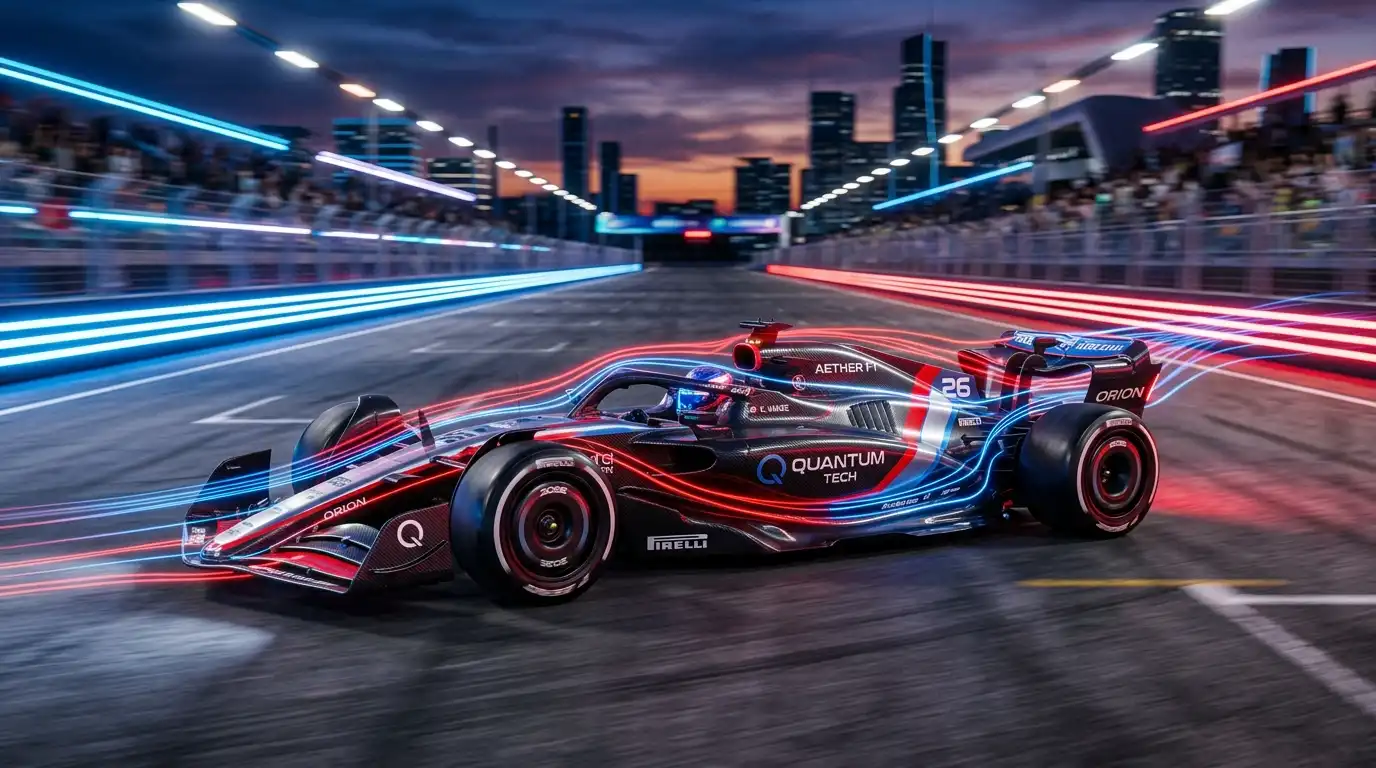
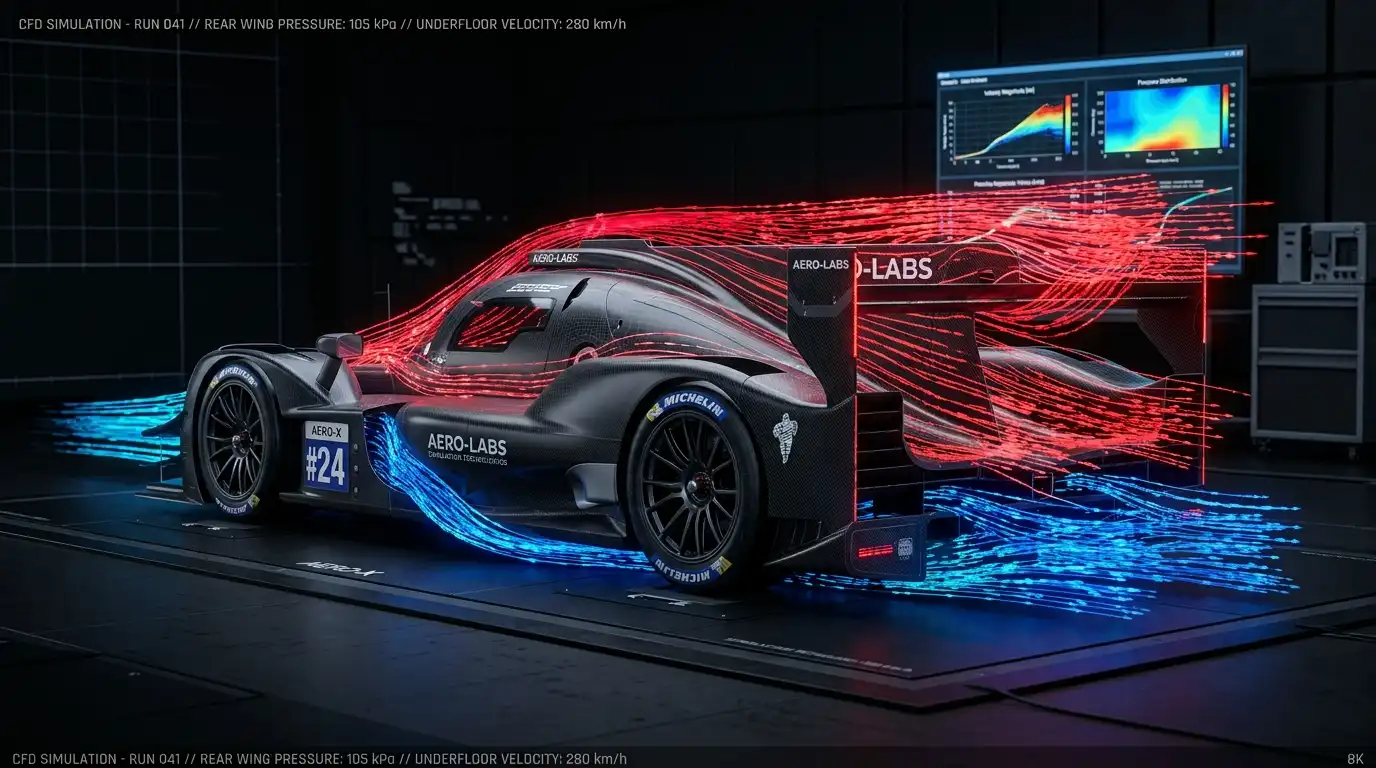
From modern Formula 1 machinery and Le Mans Hypercars (LMH) to GT3 race platforms, aerodynamicists strive to maximize vertical load while keeping the drag coefficient ($C_d$) as low as possible. Understanding how underbody Venturi tunnels work in tandem with upper body wings reveals one of the most sophisticated engineering battles in modern automotive sports.
1. Over-Body Aerodynamics: The Mechanics of Upper Wings and Splitters
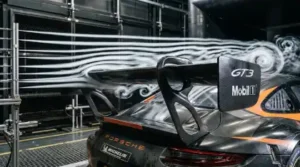
Over-body aerodynamics refers to every element designed to manipulate air flowing over the top, sides, and upper surfaces of a vehicle. Primary over-body components include front splitters, dive planes, louvers, sidepods, rear wings, and Gurney flaps.
The primary mechanism behind traditional rear wings is Bernoulli’s Principle and Newton’s Third Law of Motion:
- An inverted airfoil forces air traveling beneath it to accelerate faster than air moving over the top, creating a pressure differential that pulls the car downward.
- Simultaneously, the angled surface redirects incoming air upward, resulting in an equal and opposite downward reaction force onto the rear axle.
The Drag Penalty of Upper Surfaces
While upper body wings provide tunable, reliable downforce, they create significant induced drag. As high-pressure air above the wing attempts to spill over the sides into the low-pressure zone underneath, powerful wingtip vortices form. These turbulent air swirls create backward resistive pull, requiring more engine horsepower to punch through the air at high speeds.
2. Ground Effect Aerodynamics: The Magic of Underbody Venturi Tunnels
Instead of relying purely on upper wings, modern race cars generate the majority of their downforce underneath the floor through ground effect aerodynamics. By treating the space between the track surface and the bottom of the chassis as a closed fluid channel, engineers harness the Venturi Effect.
The underbody of a ground-effect car is sculpted into contoured channels called Venturi tunnels:
- Throat Constriction: As ambient air enters beneath the front floor, the tunnel narrows. To maintain continuous mass flow rate, the air velocity accelerates rapidly through this constricted “throat.”
- Pressure Drop: According to fluid dynamics, as fluid velocity increases, static pressure decreases proportionally. This rapid airflow creates a massive low-pressure vacuum zone underneath the floor, literally sucking the chassis toward the asphalt.
- Diffuser Expansion: At the rear of the floor, the tunnels expand upward into a diffuser. The widening area gradually slows the high-speed air back down to match ambient atmospheric pressure, preventing flow separation and expanding the vacuum effect further upstream.
Because the road surface itself acts as a physical boundary wall sealing the air underneath, underbody downforce is exceptionally efficient—generating substantial load with only a fraction of the drag created by exposed upper wings.
3. Aerodynamic Efficiency: Comparing Downforce-to-Drag Ratios
In race car telemetry, aerodynamic performance is evaluated using the Lift-to-Drag ratio ($L/D$), where “lift” refers to negative lift (downforce). A higher $L/D$ ratio represents a more aerodynamically efficient car.
To examine the fundamental technical differences between ground effect and over-body aero, consider the following performance comparison:
| Aerodynamic Feature | Over-Body Aero (Wings & Splitters) | Ground Effect (Underbody Tunnels) |
|---|---|---|
| Primary Downforce Location | Upper chassis, front axle, and rear wing assemblies. | Underside of floor and rear diffuser area. |
| Aerodynamic Efficiency ($L/D$) | Moderate ($2.0:1$ to $3.0:1$ typical efficiency). | Extremely High ($4.0:1$ to $6.0+:1$ efficiency). |
| Induced Drag Penalty | High drag due to exposed surface area and wingtip vortices. | Low drag due to enclosed airflow under the floor. |
| Sensitivity to Ride Height | Low to Moderate (works consistently across pitch variations). | High (requires strict ride height control to prevent stalling). |
| Wake Disturbance (“Dirty Air”) | Large, turbulent wake that disrupts following cars. | Clean, upwardly directed wake that permits closer racing. |
4. The Engineering Challenges of Underbody Aerodynamics
If ground effect downforce is so efficient, why don’t race cars rely 100% on floor-generated load? The answer lies in platform sensitivity and mechanical dynamics.
Ride Height Sensitivity & Aerodynamic Stalling
Venturi tunnels require a consistent seal against the ground to maintain high-velocity airflow. If the car rolls, pitches, or leans excessively during cornering or heavy braking, the air gap changes dramatically:
- If the floor sits too high, air velocity drops and underbody vacuum collapses.
- If the floor touches the track surface, the air pathway is choked, leading to a sudden loss of downforce.
Porpoising and Vertical Oscillation
As seen during recent Formula 1 technical eras, extreme underbody downforce can cause porpoising—a violent vertical bouncing motion. As downforce increases at high speed, the car is sucked down until the floor chokes, losing downforce. The chassis suddenly pops back up, re-attaching airflow and instantly repeating the cycle. Controlling this phenomenon requires ultra-stiff suspension setups and precise floor edge vortex management.
5. Synergy: How Modern Race Cars Combine Both Concepts
In modern high-performance racing, over-body and under-body systems do not work in isolation; they form an integrated system:
Front splitters condition and direct clean airflow into the underbody Venturi intakes. Meanwhile, high-mounted rear wings use their upward wake flow to assist the diffuser below, creating a low-pressure scavenging effect that pulls air out of the floor tunnels even faster. To dive deeper into formal aerodynamic testing protocols, consult the Official FIA Technical Regulations & Standards.
Conclusion: The Pursuit of Efficient Speed
The battle between downforce and drag remains a core challenge in race car engineering. While over-body wings provide crucial balance, high-speed stability, and quick adjustability across different track layouts, ground effect aerodynamics offers the ultimate path to efficient cornering grip. By combining sculpted underbody Venturi floors with targeted over-body surfaces, modern race cars achieve cornering speeds once thought impossible—all without sacrificing straight-line performance.