The Science of the Wake: How the Air-Block Works
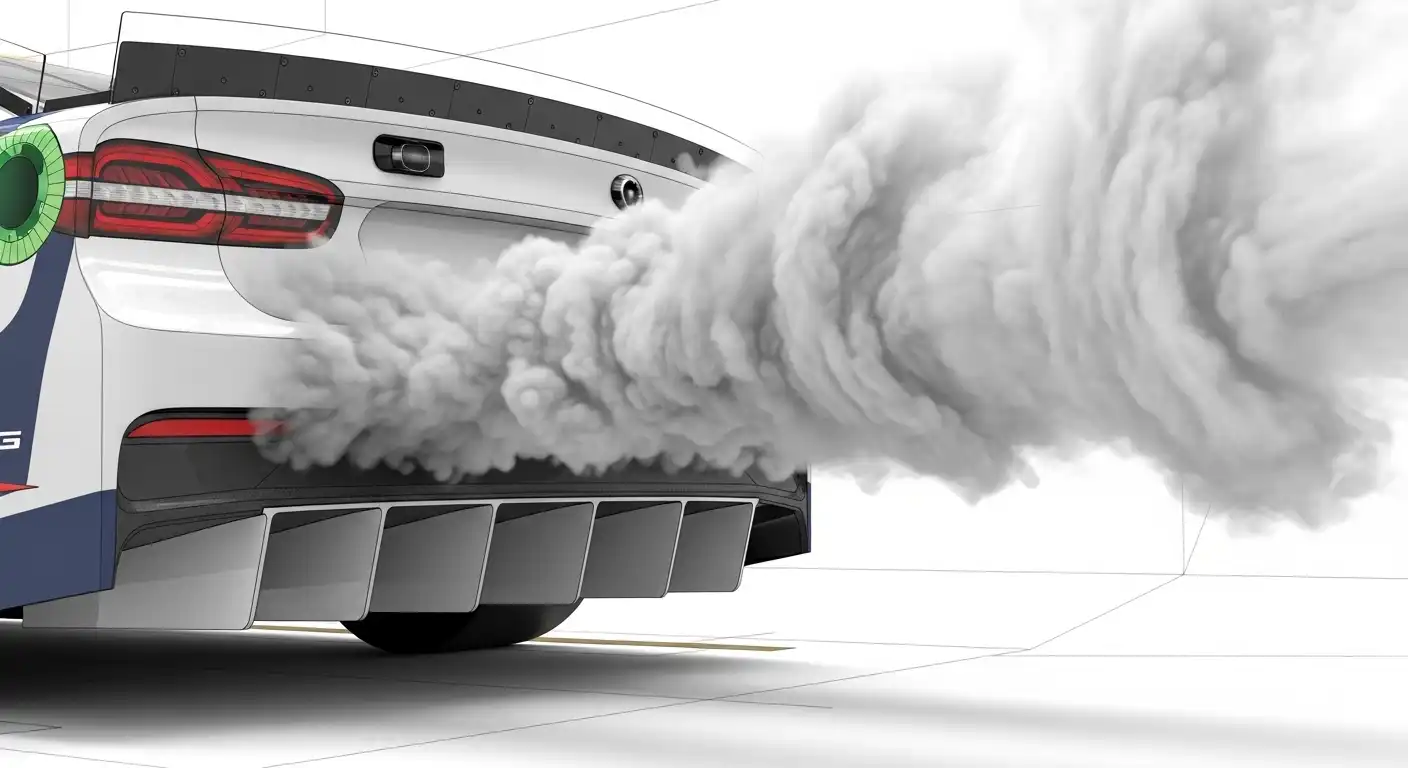
 To understand the Air-Block, one must understand the 2026 rear-diffuser assembly. The diffuser is designed to accelerate air under the car, creating a low-pressure zone that sucks the chassis to the track. In a perfect world, this air exits the rear in a smooth, laminar flow, allowing the following car to utilize the “draft” without losing grip.
Laminar vs. Turbulent Exit
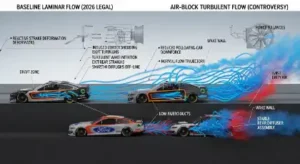
The “Air-Block” technique involves intentionally disrupting this exit flow. By manipulating the vortex generators located within the aero-ducts, teams are forcing the air to “tumble” as it leaves the rear of the car. This creates a “rooster tail” of dirty air. For the following driver, this feels like driving into a vacuum; the front tires lose their bite, the car pushes toward the wall, and the pass is neutralized before it even begins.
This isn’t a new concept in racing, but the 2026 implementation is uniquely sophisticated. Unlike traditional “side-drafting,” the Air-Block is a passive-aggressive aerodynamic shield that works even when the cars are lined up nose-to-tail.
The “Reactive Strake” Loophole
NASCAR Rule 14.4.1.A is very clear: “Any device or construction that is designed to change the aerodynamic characteristics of the vehicle while in motion is prohibited.” This is the rule that bans active wings and moveable flaps. So, how are teams getting away with it?
Aero-Elasticity: The Invisible Mover
The technicality lies in aero-elasticity. Brilliant engineers at several flagship teams have developed carbon-fiber layups for the internal aero-duct strakes that are rigid during static inspection but “deform” under the immense air pressure found at 190 MPH.
- Static State: When the car is in the inspection bay, the strakes are perfectly vertical and compliant with the 1.5-degree tolerance.
- Dynamic State: At high speeds, the air pressure causes the strakes to “flutter” or bow outward. This deformation changes the duct’s geometry, triggering the turbulent Air-Block wake.
Teams argue that this is simply “material fatigue” or “unavoidable flex” inherent to lightweight composites. NASCAR, however, suspects that the carbon weave was engineered specifically to fail-to-shape at a specific PSI threshold.
NASCAR R&D Response and the “Stiffness Test”
Following the complaints from several independent teams who lacked the budget for advanced composite R&D, NASCAR’s R&D Center in Concord has taken action. They have begun using a “point-load” test on the internal diffuser components, applying specific pressure to the strakes to measure deflection.
Reports suggest that a new Technical Bulletin (TB-2026-08) is imminent. This bulletin is expected to mandate a maximum deflection of 2mm under a 50lb load. If the strakes flex more than that, the car is illegal. This mirrors the “rear wing flap” controversies we’ve seen in other high-downforce series, including the F1 2026 “Closing Speed” safety crisis, where unpredictable aero-behavior led to dangerous closing rates on straights.
Impact on Race Strategy and Logistics
 The Air-Block controversy has completely shifted the meta-game for the 2026 season. Previously, teams focused on “raw drag reduction.” Now, they are focusing on “defensive aero.” This has led to a surge in the shipping of custom-molded floor sections. Teams are now bringing three or four different diffuser configurations to the track, each tailored to the specific wind conditions of the weekend.
From a logistical standpoint, this is a nightmare. As we discussed in our recent analysis of trucking fleet efficiency and NASCAR logistics, the sheer volume of delicate carbon-fiber components that must be transported securely has increased by 40% this season. Each “Air-Block” compliant floor is a $25,000 asset that requires specialized climate-controlled transport to prevent the resin from shifting during transit.
Comparison Table: 2025 vs. 2026 Aero Rules
| Feature | 2025 Specification | 2026 Specification (The Change) |
|---|---|---|
| Diffuser Strakes | Fixed Aluminum | Hybrid Composite (Source of Controversy) |
| Underbody Venting | Single Center Channel | Dual “Aero-Duct” System |
| Wake Profile | Narrow/High | Wide/Low (Target for Manipulation) |
| Inspection Method | Visual/Laser Scan | Laser Scan + New Pressure/Stiffness Load Test |
Conclusion: The Future of the Next-Gen Platform
The Air-Block controversy is a classic example of racing’s “arms race.” As soon as the sanctioning body closes one door, the engineers open a window. While NASCAR will likely stomp out the intentional use of aero-elastic strakes by mid-summer, the knowledge gained about wake manipulation will remain.
For the fans, this means that passing will remain a premium skill. For the engineers, it means the hunt for the next “gray area” begins immediately. Whether it’s through wheel-well venting or rear-quarter-panel oscillation, the battle for clean air—and the ability to deny it to others—will define the 2026 champion.